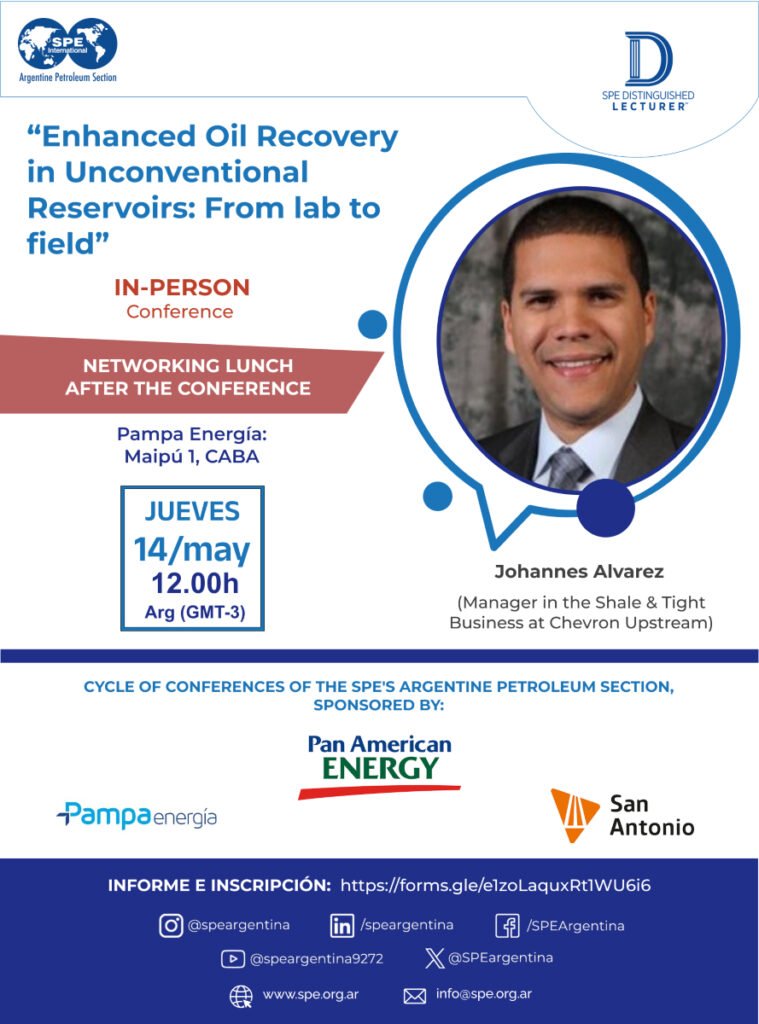
FECHA: Jueves 14 de mayo, 2026 a las 12:00 PM (GMT -3)
Expositor: JOHANNES ÁLVAREZ – Manager in the Shale & Tight Business at Chevron Upstream.
Modalidad: Presencial – Evento no arancelado – CUPOS LIMITADOS
Dirección: Pampa Energía, Maipú 1, CABA.
IMPORTANTE:
La inscripción es un compromiso de participación, ya que hay cupos limitados. En caso de no poder asistir, se ruega comunicar la baja 48 hs antes para dar lugar en la lista de espera.
Inscripción: AQUÍ
.
.
.
RESUMEN DE LA CONFERENCIA
Unconventional reservoirs development depends on primary depletion, which uses the initial reservoir energy to produce hydrocarbons through complex fracture networks. Production results in high initial fluid rates that quickly drop and stabilize at low levels. Enhanced Oil Recovery (EOR) technologies can improve unconventional well recovery, lower base decline, and prolong the life of these fields.
This presentation contrasts conventional and unconventional EOR and describes lab observations, recovery mechanisms as well as workflows, surveillance, and results for developing and field-testing two EOR technologies in unconventional reservoirs. The first field case is the use of surfactants in existing horizontal wells. Chemical EOR is a technique that boosts oil recovery by injecting chemicals that alter the interactions between fluids and rocks. It has been widely used in conventional reservoirs, but it is challenging and needs careful design and execution to apply it in unconventional reservoirs. The second field case is a hydrocarbon gas EOR application under a huff and puff scheme. Gas EOR is a technique that targets the oil that stays in the depleted formations that cannot be produced due to low energy. It recharges the unconventional reservoir by decreasing oil viscosity and helping oil swelling. In both field cases, various analysis techniques, including analytical methods and tracer responses, are combined with production and productivity index to provide an integrated interpretation. Lab and field results confirmed the main recovery mechanisms with measurable EOR responses. This presentation offers valuable insights and lessons learned for the use of chemical and gas EOR in unconventional reservoirs and suggests future directions and opportunities for further improvement.
The key message I want to share with SPE members in this lecture is that EOR technologies can increase recovery factors in unconventional reservoirs, but they are different from conventional reservoirs in terms of methods, application, and timing, because of the complex petrophysical characteristics and recovery mechanisms of unconventional reservoirs.
.
Bio
Dr. Johannes Alvarez serves as the Enhanced Oil Recovery Manager in the Shale & Tight Business at Chevron Upstream. With over 23 years of experience as a Senior Reservoir and Production Engineer, he has contributed significantly to both industry practices and research and development. Before his current roles, Dr. Alvarez held leadership positions in Production Engineering and Strategic Planning at Petroleos de Venezuela S.A. (PDVSA). His broad technical expertise includes asset development, production, facilities and process engineering, cross-functional pilots, and IOR/EOR processes across various reservoir types. He is a prolific author of journals and technical papers on EOR/IOR in unconventional and heavy oil reservoirs.
Dr. Alvarez has a long history of serving SPE, showing technical leadership as Co-Chair of Unconventional Resources Technology Conference (2021-2025), Co-Chair of the SPE Midland Basin Energy Conference (2022-2025), Chairperson of the 2026 SPE Latin American and Caribbean Petroleum Engineering Conference, and Forum Chair for the 25th WPC Energy Congress. He is also a technical editor for SPE and other journals and contributed as a member of the SPE Reservoir Advisory Committee and as Chairperson of the SPE ATCE Reservoir Engineering Subcommittee. Dr. Alvarez has been named 2025-2026 SPE Distinguished Lecturer and is an Industry Board member for the Texas A&M University Petroleum Engineering Department.
Dr. Alvarez holds a PhD in Petroleum Engineering from Texas A&M University, an MSc from Stanford University, and a BSc from Universidad Simon Bolivar, both in Chemical Engineering.
.
.